
With All Due Respect, Kathleen
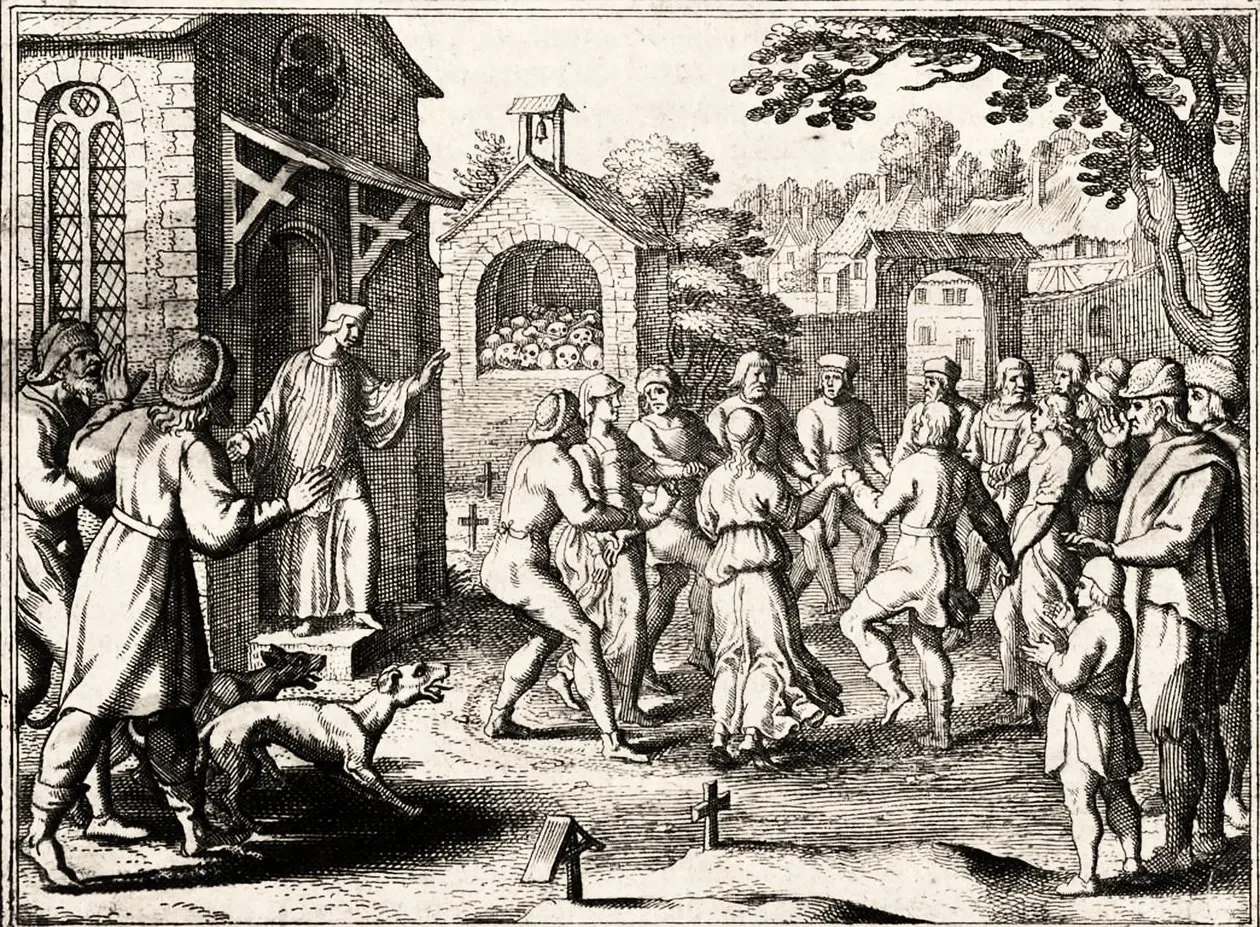
The Dancing Plagues of 1518 in Strasbourg started with women. Eventually, groups of people danced uncontrollably. Historians suggest the cause was stress-induced mass psychogenic illness driven by famine and disease, ergot poisoning or curses by St. Vitus… The exact aetiology is still unclear.
If you’re a young woman who has found herself needing to use a mobility aid and are suitably perplexed by your symptoms or diagnosis, don’t stress! Kathleen Stock has solved the mystery for you.
You, obviously, have a case of social contagion.
More precisely, “non-specific symptoms and social contagion”.
And her healing, empathetic advice is to “ditch the props, and quite literally stand on [your] own two feet.”
You’re CURED!
Like most people in the disability and chronic illness community, I read this article, published in The Times no less (a conversation on publisher integrity for another time), and wanted to throw my phone across the room.
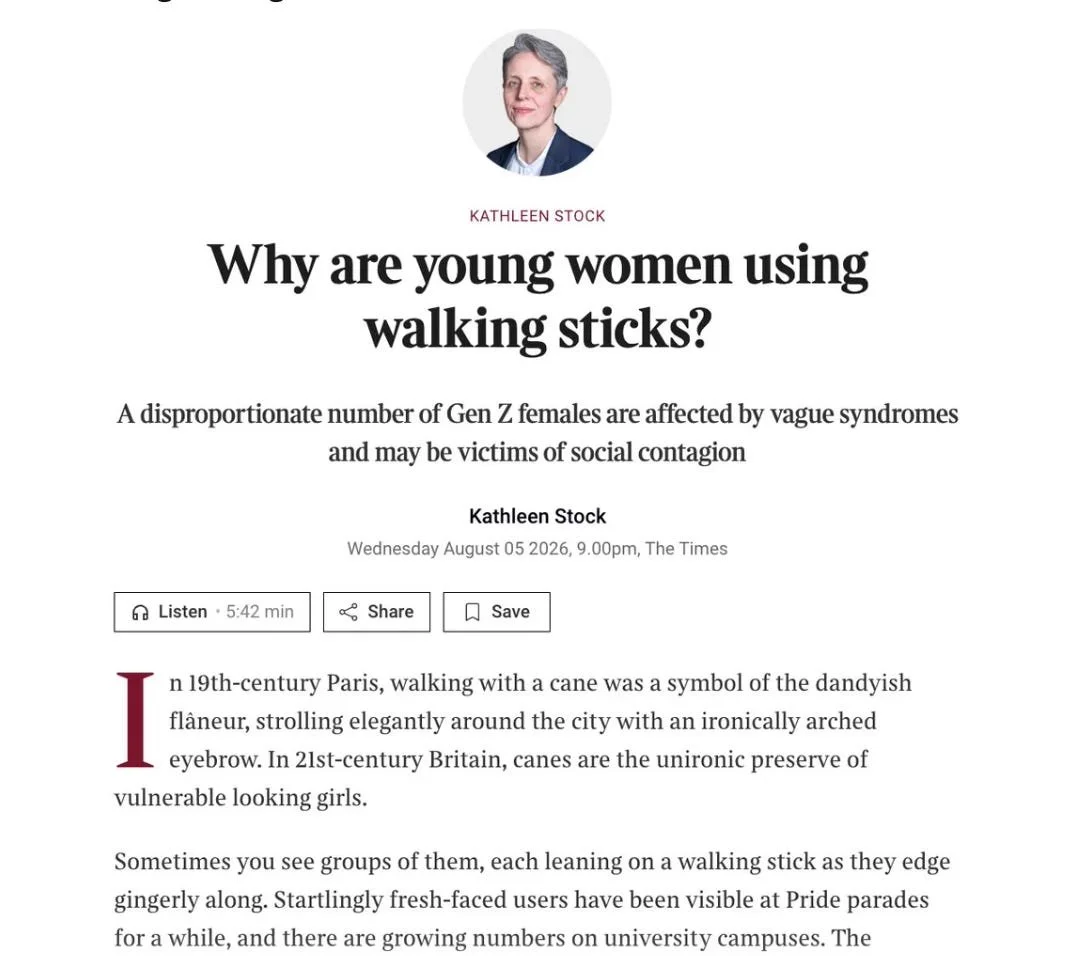
Kathleen Stock’s bullshit article in The Times
Really, Kathleen?
So we’re clear about where this author is writing (and seething) from: I use mobility aids, and I use them begrudgingly. My reasons are mechanical and neurological. My body has been the victim of poor engineering and consequent nerve problems that make support necessary on the hard days. I have not accepted this is my reality yet. That I’ve gone from a 5-day-a-week CrossFitter to someone who can barely walk the dogs. The resistance to mobility aids is so visceral that I’m building an entire company to resolve the many aesthetic and functional issues with these devices.
All that to say, there was no trend, no algorithm, and no costume involved in my picking up a cane. So when a columnist reduces people like me to a fashion or a phase, I have many things to say, and I have organised them into three.
1. This is cause and effect, not a mystery.
The question posed in the column is around why so many young women seem to need support now, as though bodies were uniformly sturdy until recently. The answer, I think, is sitting in plain sight.
Remember how not so long ago we lived through a global viral pandemic?? It is well documented that viral illnesses like EBV, COVID, etc. leave a wake of destruction behind them. Those conditions land disproportionately on women.
In the United States, women were more likely than men to report long COVID, at 8.5 percent versus 5.2 percent by 2022. COVID is also linked to a rise in conditions like POTS, a form of dysautonomia that affects an estimated 1 to 3 million Americans, roughly 80 to 85 percent of them women, most of childbearing age. Post-viral fatigue conditions follow the same pattern, with ME/CFS diagnosed in women 2 to 4 times more often than men.
At the same time, thanks to social media and the urge to leave the house every once in a while, we’ve got better at naming things. Because the choice is to hide what’s wrong with you and sacrifice a rich, juicy life, or use the damn mobility aid and get on with things.
A cane that a generation ago lived in a cupboard now gets posted, described, styled and, importantly, recognised by a hundred other people with the same diagnosis. More visibility and more diagnoses do not mean a new illness simply fell out of the sky. They mean we finally started looking, and people finally felt safe enough to be seen.
2. “Social contagion” is very old wine in new bottles. And Kathleen is decanting.
If there were ever a contest for “laziest argument ever made”, social contagion would take the crown. History has exhumed the very flogged, very dead horse of social contagion since time immemorial. It gets dredged up, generation after generation, every time women are unwell.
Let’s start with hysteria. It is the first mental disorder attributed to women, described as far back as the second millennium BC and treated as an exclusively female disease for roughly 4000 years. Hippocrates and Plato (notably, not women…) blamed a “wandering womb” for symptoms they could not explain. For millennia, hysteria worked as a catch-all label. The medical explanation for everything men found mysterious or unmanageable in women.
Then history watched the same move repeat under new names. Mass psychogenic illness, once called mass hysteria, has a documented history that lands again and again on young women. The dancing plagues of medieval Europe, from Aachen in 1374 to Strasbourg in 1518, erupted under famine and disease and were blamed on the afflicted rather than their conditions. The Salem witch accusations of 1692 began with convulsing young women. In 1962, a “June Bug” outbreak swept through female textile workers. In 2011, a cluster of tics among teenage girls in Le Roy, New York became the first such episode widely blamed on social networks, and the TikTok tic stories of 2020 and 2021 are simply the latest edition. I told you. Old wine, new bottles.
(Fun fact: I am surprisingly qualified to comment on this as I actually studied the history of witchcraft at university as a breadth subject! Completely unrelated to my degree, but it turned out to be the most interesting thing I took, enough that I signed up for the extension classes too. Witch accusations ran on misogyny far more than the supernatural. They were a way to punish women who were too loud, too odd, too old, too independent, or simply too inconvenient.)
Every era invents a fresh label for the same reflex.
When young women report bodies doing something inconvenient or hard to explain, our culture reaches for contagion before it reaches for curiosity. And while it reaches, women wait.
Endometriosis, which affects around 1 in 10 women, takes an average of 6.6 years to diagnose worldwide, and up to 27 years in the UK, with the average patient seeing 7 doctors first.
Women with POTS wait nearly twice as long as men for a diagnosis, 7 years versus 3.8, and are 2.6 times more likely to be placed on a mental health plan along the way.
Autoimmune disease, which is diagnosed in women around 80 percent of the time, routinely gets mistaken for anxiety first. Study after study on the gender pain gap finds the same thing: women are judged to exaggerate their pain and are steered toward psychological treatment while men with the same symptoms are given pain relief.
So calling this “social contagion” adds nothing new. Net zero. Kathleen simply recycles hysteria with a modern vocabulary, and it does the same job it always did, which is to pathologise women rather than ask why so many are unwell.
3. Mobility aids are tools, not confessions of failure
The idea that a body has to be consistently broken to deserve support is a made-up rule that helps no one.
A cane, a rollator, a wheelchair are tools. Tools that expand what a person can do.
Tools that let me go to a networking evening and land a potential new client meeting, growing my business. Tools that let me go to a friend’s birthday lunch. Tools that help me live a life as close to normal as I remember it.
Telling me to “stand on my own two feet” is the same as telling someone to walk to the office. Sure, I could, but my office is 40 kilometres from my house, and most people have no wish to spend 6 hours a day in transit. A car is a tool, and no one calls a driver weak for using one.
And despite what Kathleen might think, using a mobility aid on hard days and not on others is legitimate. Intermittent need is still need. I live this. Some days my body cooperates and some days it does not, and a stick is the difference between joining the world and staying home.
I will grant one narrow point Kathleen's way. Social media has produced a small subset of people who perform illness, posing symptoms or amplifying ones that were shaky to begin with. That is probably who Stock is really reacting to. Even so, I can’t help but think these people need compassion too. Performing illness is a kind of illness in itself. Well-balanced people do not perform disability, and the ones who do need help just as much as anyone, only of a different kind.
So, if that’s really who she’s talking about, building an entire column around that tiny minority, and using it to wave away everyone who is genuinely unwell, is lazy at best and obscenely damaging at worst.
We do not need this discourse. It costs disabled women something real every time it runs, and it teaches the next young woman to delay, to doubt herself, and to leave the cane by the front door a little longer.
Any young person who uses a mobility aid due to a dynamic condition knows the exhausting mental gymnastics that come with it. The incredible mental fortitude to continue reminding yourself that the only person who suffers if you don’t use it is YOU. That people will stare and you need to press on regardless.
If Kathleen Stock actually cared about these young women, she would spend less energy telling us to drop our “props” and more asking why so many of us reach for them in the first place. That’s a topic worthy of proper journalism.
The answer has been sitting in medical journals all along, waiting for ignorant “journalists” (derogatory) like her to open one.
We’re creating innovative mobility aids for the young women Kathleen Stock claims to care about. Except we actually do, because our founder is one of them.
If you want to be part of shaping what comes next, you can:
Join the Wayfarer Facebook community: Join here →
Share your voice in our survey: Take the survey →
Follow Wayfarer Mobility on socials: @wayfarer_mobility